

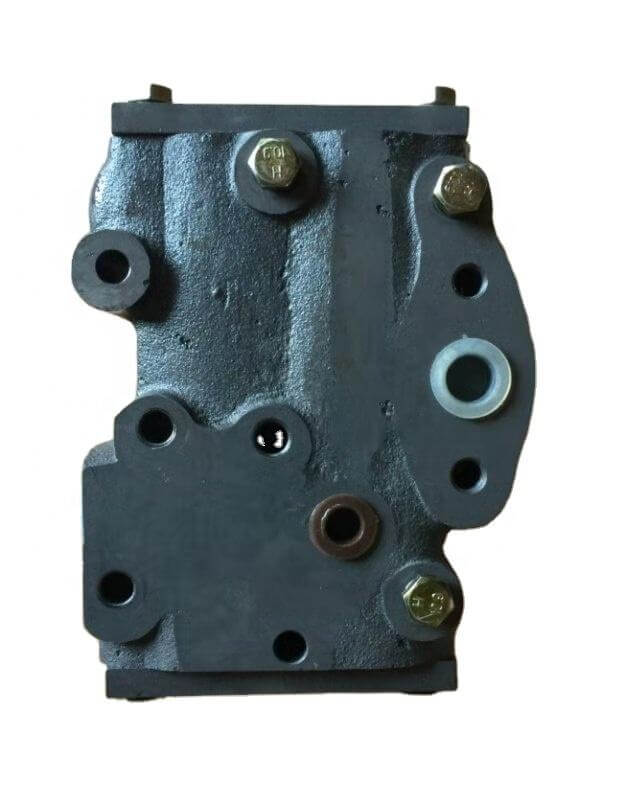
Control Arms for Heavy Equipment, Wheel Loaders, and Backhoe Loaders
Control arms define the geometric position of the wheel hub assembly throughout the entire suspension travel range on wheel loaders and backhoe loaders. Imara Engineering supplies heavy equipment control arms within our Suspension and Steering Parts range, covering Cat, Komatsu, JCB, and Case.
Every control arm we supply is matched to OEM specification in geometry, material grade, and pivot bore tolerance for your specific machine. Whether you need an upper control arm, a lower control arm, or a complete assembly, our range covers wheel loader and backhoe loader platforms across the leading brands. Aftermarket options meet full engineering standards, and we ship worldwide.


Collection:
Control Arms
The Component That Holds Suspension Geometry in Place
The control arm's job is precision, not just strength. On wheel loaders and backhoe loaders, the front suspension is a precisely engineered geometry, a defined set of angular relationships between the chassis, the axle, the wheel hub, and the ground contact patch of the tyre. The control arm is the structural link that holds that geometry in its correct position through every load cycle, every ground irregularity, and every articulation event the machine encounters in service.
Upper and lower control arms work as a pair, constraining the wheel hub assembly to a defined arc of travel as the suspension moves through its designed range. That arc determines camber angle, how upright the tyre sits against the ground surface,e and it defines the angle at which the ball joint, connecting the control arm to the hub, is loaded during operation. Every component attached to the control arm, including the ball joints at its outer end, the suspension bushings at its inner pivot, the wheel hub assembly it supports, and its dependencies, depends on the arm maintaining its correct geometry throughout the machine's service life.
When a control arm is damaged, bent, or structurally compromised, it does not just affect its own function. It changes the geometric reference that every connected component was engineered to operate with, thin, and the consequences cascade outward across the entire front suspension assembly.
Upper and Lower Control Arms: One Geometric System, Two Structural Roles
On heavy equipment platforms that use a double-wishbone-style front suspension geometry, upper and lower control arms function as a coordinated pair. Each arm has a distinct structural role, and each fails in characteristically different ways.
Upper Control Arms on Heavy Equipment
The upper control arm manages the upper pivot point of the wheel hub assembly, defining the upper end of the suspension travel arc. On wheel loaders, the upper arm is typically the shorter of the two in most suspension configurations, a geometry that produces a progressive camber change through suspension travel, reducing tyre scrub and stabilising the machine during load and travel cycles.
Because the upper arm carries a lower proportion of the total axle load than the lower arm, its primary failure mode is impact damage rather than fatigue loading. A ground strike or contact with a hard obstacle during confined-space manoeuvring can bend the upper control arm without destroying it visibly, and the geometric deviation it causes can persist across multiple production shifts before tyre wear data reveals the alignment error. The absence of obvious physical damage does not mean the arm is holding its correct geometry.
Lower Control Arms on Heavy Equipment
The lower control arm carries the dominant share of vertical load from the wheel hub assembly and is the primary structural element of the front suspension on wheel loaders and backhoe loaders. Its larger cross-section, longer span, and heavier construction reflect the sustained load intensity it manages through every loaded work cycle.
Lower control arm fatigue failure develops differently from upper arm impact damage. The failure mode is structural fatigue initiated at weld toes, at stress concentration points around pivot bore locations, and at areas where section changes create bending moment concentrations under repeated loading. This type of failure rarely announces itself with a sudden visible event. It presents first as progressive geometric drift in the machine's straight-line tracking behaviour, in tyre wear asymmetry, and in the accelerated wear rate of the ball joints and suspension bushings connected to an arm that is no longer holding its correct angular position.
Six Field Indicators That a Control Arm Requires Inspection or Replacement
Control arm damage and fatigue are not always immediately visible. The following field indicators are the most reliable signals that a wheel loader or backhoe loader control arm warrants a thorough inspection and, in most cases, immediate replacement before the next loaded production period:
- Accelerated tyre wear concentrated on one side of the front axle. A control arm that has bent or fatigued below its correct geometry produces a measurable camber or toe deviation that consumes tyre tread on the affected wheel with every loaded cycle, irrespective of tyre pressure or rotation schedule.
- A pulling or tracking deviation to one side on a flat surface without any steering input, but a straight-line deviation on a machine with recently inspected steering components, typically points to a control arm geometry issue as the remaining unexamined variable in the suspension system.
- Visible bending, cracking, or deformation at any point along the arm or body, any permanent deformation of the control arm section, means the arm is operating outside its designed geometry and must be replaced immediately, regardless of whether other symptoms have appeared yet.
- Stress cracking at weld toes or pivot bore locations, fatigue cracks initiating at weld interfaces or bore reinforcement areas,s are the characteristic lower control arm failure mode under sustained cyclic loading and must be treated as a critical finding requiring immediate replacement, not monitoring.
- Elevated wear at a ball joint that was recently replaced in a correctly specified assembly. If a ball joint is showing accelerated wear shortly after replacement, the most probable cause is that the control arm holding it is running at an incorrect operating angle, placing the joint under loads outside its design envelope.
- Detectable lateral movement at the wheel hub during a stationary pivot check with the machine supported off the ground and engine off, any visible lateral movement between the wheel hub and the axle knuckle during a manual load application confirms the control arm geometry is no longer constraining the hub to its correct travel arc.
Machine Platforms We Cover
Our heavy equipment control arm inventory is catalogued to support the following OEM platforms:
Caterpillar (Cat)
- Cat wheel loader control arm assemblies for the Cat 966 and Cat 972 series upper and lower positions, individual arm replacements, and complete control arm kits.
- Control arm assembly options covering the broader Cat wheel loader range,e where the OEM suspension design uses a double-wishbone geometry at the front axle.
Komatsu
- Komatsu wheel loader control arm assemblies for the Komatsu WA380 and WA-series platforms — upper and lower positions, complete assembly, and individual arm options stocked.
JCB
- JCB control arm assemblies for the JCB 3CX backhoe loader and JCB wheel loader series — upper and lower positions, individual and complete control arm kit configurations available.
Case
Case control arm units for backhoe loader and wheel loader platforms, RMS upper and lower arm positions, available as individual replacements and complete kit assemblies for full front suspension refresh programmes.
If your machine model is not listed above, contact our team with the serial number and model number, and we will confirm the correct specification and stock availability before any order is placed.
Replacing a Control Arm in Context: What Else Requires Attention
A control arm replacement on heavy equipment should never be treated as a standalone event. The arm is the geometric anchor point for several components in the suspension assembly, and the condition that required the replacement,ement whether impact damage, weld fatigue, or sustained operation with degraded geometry,ometry will typically have affected those connected components as well.
At the point of control arm replacement, these adjacent components require simultaneous inspection and, in most cases, concurrent replacement:
- The control arm bushings at the inner pivot, if worn or dd, must be replaced alongside the arm. A new control arm installed into degraded pivot bushings will lose its geometric accuracy within the first loaded operating hours, negating the purpose of the replacement entirely.
- The ball joint at the outer pivot, particularly where the arm has been operating in a compromised geometric position, the ball joint will have been loaded at an incorrect angle, and its remaining service life may be considerably shorter than its visual wear indicators suggest.
- The wheel hub and bearing assembly is supported by the replaced arm; any geometric deviation in the control arm transfers directly into the hub bearing loading profile, and a bearing that has been running in a misaligned condition will have consumed a disproportionate share of its rated design life.
Replacing the control arm while leaving degraded components connected to it is the single most common reason a control arm replacement fails to deliver its expected service interval.
Frequently Asked Questions
Both options are available. Individual upper and lower arm replacements are stocked where only one position requires attention. Complete control arm kits covering both positions on one side or all front axle positions are available for full suspension refresh programmes.
A bent arm produces measurable geometric consequences, tyre wear asymmetry,y or straight-line deviation without a visible fracture, and confirmation requires dimensional measurement against OEM specification. A cracked arm may show no geometric deviation yet,t but represents an imminent structural failure. Both conditions require immediate replacement before the machine returns to loaded production.
Yes, always. Installing a new control arm into worn pivot bushings reintroduces the geometric deviation that the replacement was designed to correct from the first operating hours. Replacing them together is the only way to restore the assembly to its correct specification at every interface.
Yes, provided the aftermarket arm is manufactured to the OEM-specified geometry, material grade, and weld specification. Dimensional accuracy is the critical variable a control arm that deviates from OEM geometry, even marginally, produces the same downstream consequences as a damaged original arm from the moment it enters service.
Most orders are dispatched within 24 to 48 hours of confirmed payment. We ship to all locations worldwide, with express freight options available for urgent breakdown requirements. Contact us in advance for less common model specifications to confirm stock availability before placing your order.