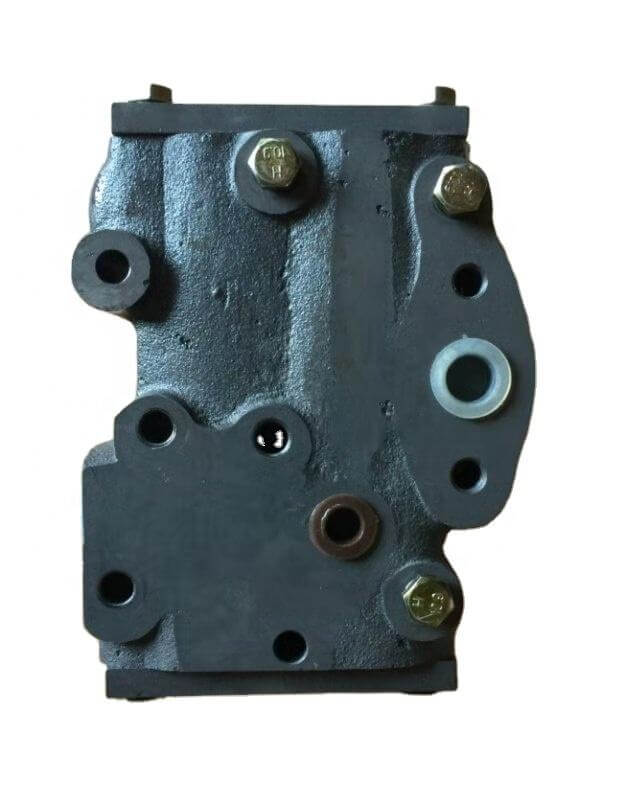
Two Components, One Circuit Position, Know Your System Before You Order
The expansion valve and the orifice tube perform the same fundamental job within the heating and air conditioning circuit; they restrict refrigerant flow at the boundary between the high-pressure and low-pressure sides of the system, dropping refrigerant to a low-pressure state before it enters the evaporator. The critical difference is in how each component manages that restriction, and identifying which your machine uses determines which part the repair actually requires.
The thermostatic expansion valve or TXV excavator unit is a mechanically active component. It responds to the temperature of refrigerant leaving the evaporator, opening or closing its metering port in real time to match refrigerant flow to the actual cooling load on the cab. This variable control keeps the evaporator operating at peak efficiency across fluctuating site conditions, making TXV systems particularly well-suited to applications where cab heat load changes significantly during operation.
The orifice tube is a fixed restriction, a precisely sized aperture embedded within a short tube section in the refrigerant line. It provides no active regulation. Flow rate remains constant regardless of load, making the system simpler in design and lower in component count, but more dependent on correct refrigerant charge and overall system balance to sustain performance across a shift.
Imara Engineering's fitment process confirms your system configuration alongside model and serial number before any order is processed.
The Most Consistently Misread Fault in Excavator HVAC and Why It Matters for Your Order
The expansion valve sits at the precise transition point between compressor output and evaporator cooling. Its failure symptoms overlap significantly with those produced by a low refrigerant charge, a partially restricted condenser, and a degraded compressor, which is what drives the misdiagnosis rate on site and in independent workshops alike.
When a thermostatic expansion valve begins to malfunction, the most common first response is a refrigerant recharge. The charge may improve symptoms temporarily, particularly if the system was genuinely low from a secondary leak, but the valve fault remains. The system underperforms again within the same season. The next investigation moves toward the AC compressors before the expansion valve is eventually identified. Two component replacements and a recharge later, the actual source of the original fault is confirmed.
Understanding the specific failure pattern each component type produces narrows the diagnosis before any parts are sourced.
Thermostatic Expansion Valve: How Failure Presents
A failing TXV valve heavy equipment unit typically presents in one of two modes:
-
Valve restricted or stuck closed — The evaporator receives insufficient refrigerant. Cooling output weakens, suction pressure falls below specification, and frost accumulates on the inlet side of the evaporator core. The cab temperature rises despite the compressor running at normal load.
-
Valve stuck open or passing excess refrigerant — The evaporator floods, suction pressure climbs, and the compressor operates under sustained elevated load. Liquid refrigerant drawn back toward the compressor causes slugging, one of the most damaging failure sequences in the full AC circuit.
Orifice Tube: How Failure Presents
Orifice tube failure in heavy equipment applications is almost always a contamination event rather than a structural failure. The fixed aperture of the orifice tube makes it vulnerable to blockage from refrigerant debris, particularly in systems where the compressor has recently failed and released internal particles into the circuit.
-
Partial blockage — Cooling output reduces progressively as refrigerant flow is restricted. High-side pressure rises, low-side pressure falls, and the system presents as if significantly undercharged.
-
Full blockage — Refrigerant flow to the evaporator is eliminated. The compressor continues to run against the restriction, building an abnormal high-side pressure. An ac orifice excavator replacement performed without flushing the full circuit removes the symptom while leaving the contamination source in place. The replacement tube blocks again within a short operating period.
The Imara Engineering Expansion Valve & Orifice Tube Range: Every Major Platform Covered
Imara Engineering's expansion valve excavator range covers both block valve AC heavy equipment configurations and inline orifice tube designs, cross-referenced by machine make, model series, and refrigerant circuit layout. Every unit is confirmed to OEM metering specification before it is listed in the catalogue.
Caterpillar (CAT) Expansion Valve
The cat expansion valve range covers 320, 323, 330, 336, 349, and 390 series excavators. CAT cab HVAC systems predominantly use block-style TXV configurations. The expansion block valve cab mounting arrangement integrates the valve body directly with the evaporator inlet fittings, which affects both the part specification and the installation approach at the housing. Fitment is confirmed by serial number to account for configuration differences across build periods.
Komatsu Expansion Valve
The Komatsu expansion valve range covers PC200, PC210, PC300, PC360, and PC400 series excavators. Komatsu HVAC systems use both inline TXV and block-style configurations, depending on model generation. Serial number verification confirms the correct valve type and refrigerant port configuration for each specific machine before the order is confirmed.
Hitachi Expansion Valve
The hitachi expansion valve range covers ZX130, ZX200, ZX300, ZX450, ZX650, and ZX870 series excavators. Hitachi cab HVAC systems vary in expansion valve mounting style across machine generations, a detail that directly affects the fitting interface with the evaporator inlet and the installation sequence within the HVAC housing. Imara's cross-referencing confirms both dimensional and specification match for every unit supplied.
Volvo Expansion Valve
The Volvo excavator expansion valve range covers EC210, EC300, EC380, and EC480 series machines. Volvo integrated climate unit designs position the expansion valve within the combined HVAC housing alongside the evaporator core, a configuration that requires precise dimensional matching to the evaporator assembly used across different build generations.
Doosan Expansion Valve
The Doosan expansion valve range covers DX140, DX225, DX300, and DX380 series excavators. Doosan HVAC configurations vary in expansion valve specification between regional build variants and production periods. Serial number verification is an essential step for accurate fitment on every unit supplied for this platform.
The Receiver Drier Comes Out at the Same Time: No Exceptions
The relationship between the expansion valve and the receiver dryer is not merely procedural; it is functional, and skipping the dryer replacement is one of the most reliable ways to repeat an expansion valve failure within the same operating season.
The receiver dryer sits upstream of the expansion valve in the high-pressure refrigerant circuit, filtering moisture and particulate matter before refrigerant reaches the valve metering port. The fine tolerances of a TXV metering port are among the most sensitive points in the full AC circuit to particulate ingress. When the dryer's desiccant is saturated, or its filter media has degraded, contaminated refrigerant passes directly to the expansion valve on every circuit cycle.
A replacement expansion valve installed alongside a degraded receiver dryer is immediately exposed to the same contamination conditions that degraded the original. Imara stocks receiver driers and accumulators matched to every machine platform in the expansion valve range. Both components can be sourced and replaced in a single service call. Beyond the receiver dryer, flushing the full circuit before recharging removes contamination load released during the valve failure period, particularly if the original fault involved a fully blocked orifice tube or a valve seized in the closed position.