

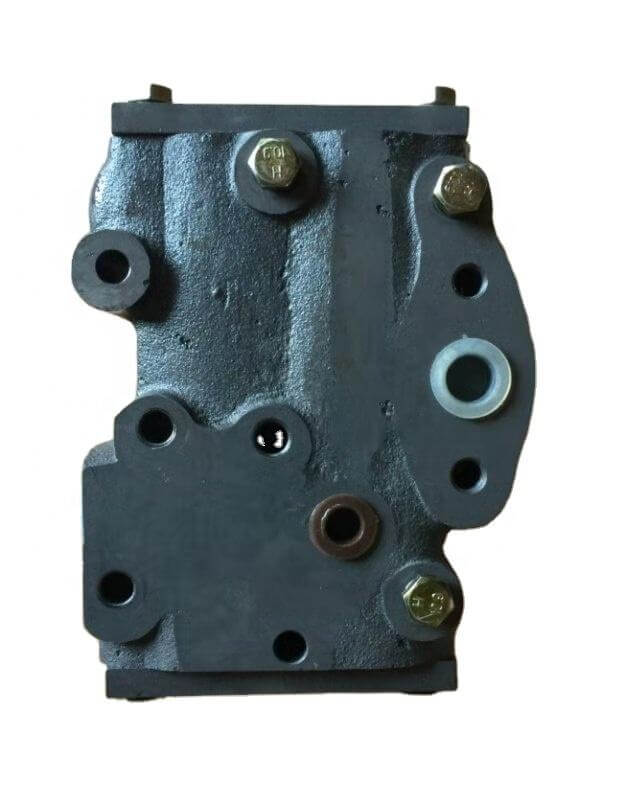
Walk up to two excavators on the same job site, and they may both have a cooling fan spinning at the front of the machine. What you cannot see from the outside is that one of them is driven by a hydraulic motor drawing flow from the main hydraulic circuit, while the other is driven by an electric motor controlled by the machine's ECM.
The component looks similar. The symptom of failure looks similar. But the diagnosis, the replacement procedure, and the part you order are completely different depending on which drive system your machine uses.
Getting this wrong, ordering a hydraulic fan motor for a machine with an electric fan drive, or investigating the hydraulic circuit on a machine whose fan is electrically controlled, is the kind of misdiagnosis that costs a day of labour and a week of lead time.
This guide explains exactly how each system works, how each one fails, and how to confirm which system your machine uses before anything is ordered.
For OEM-quality hydraulic fan motors and fan drive components for CAT, Komatsu, and Hitachi excavators, visit our fans and fan motors collection.
If your excavator is already showing cooling fan failure symptoms, read our companion guide to excavator cooling fan failure first to confirm the fault before identifying the correct replacement.
The Fan Motor's Job: Why It Matters
Before distinguishing between the two drive systems, it helps to understand what the fan motor is actually doing.
Think of the fan motor as the engine of a ventilation system in a large building. The radiator, oil coolers, and intercooler in your excavator are like the vents and ducts, well-designed to move heat, but completely passive. They cannot do anything without the fan motor driving airflow through them.
The fan motor is the active element that makes the entire passive cooling stack functional. A radiator rated to reject 50 kilowatts of heat does exactly zero kilowatts of heat rejection if there is no airflow across it. The fan motor is what determines whether the cooling system's rated capacity is actually delivered to the machine.
This is why, as noted in Caterpillar's Machine Systems Fundamentals technical reference, "fan drive system performance has a greater influence on overall cooling system capacity than any individual cooler component in the stack."
Hydraulic Fan Drive Systems: How They Work
The hydraulic fan drive is the dominant configuration on modern medium and large excavators, including the CAT 320 and 336 series, the Komatsu PC200 and PC300 series, and the Hitachi ZX200 and ZX350 series.
Imagine a water wheel at a mill. Water (hydraulic fluid) flows from a source (the hydraulic pump), pushes against the blades of the water wheel (the fan motor's internal rotating group), and causes the wheel to spin. The speed of the wheel is directly proportional to how much water is flowing. The hydraulic fan motor works on exactly this principle: hydraulic fluid from the machine's circuit flows into the motor, causes the internal piston or gear mechanism to rotate, and that rotation drives the fan blade.
How hydraulic fan drives vary fan speed:
Most modern hydraulic fan systems use a variable displacement pump or a proportional control valve to modulate fan speed based on cooling demand. When the engine is cold or lightly loaded, less hydraulic flow goes to the fan motor, and the fan runs slowly. When the machine is working hard in high ambient temperatures, full flow is directed to the fan motor, and it runs at maximum speed.
Hypothetical example: a Komatsu PC300-8 operating on a mine site in the Northern Territory at 40°C ambient temperature. The machine starts cold in the morning the fan runs at roughly 40% of maximum speed. After two hours of continuous digging at full hydraulic load, the fan is running at 95% of maximum speed, the hydraulic system is commanding maximum flow to the fan motor, and the cooling stack is operating at near-peak heat rejection capacity. The variable speed system achieved this automatically, without any operator input.
Electric Fan Drive Systems: How They Work
Electric fan drives are more common on smaller compact excavators and newer Tier 4 and Stage V emissions-compliant machines where electronic engine management is tightly integrated across all vehicle systems.
Analogy: if the hydraulic fan drive is a water wheel responding to water flow, the electric fan drive is a ceiling fan with a variable speed controller. The ECM (engine control module) acts as the controller it reads temperature sensor data from the engine, hydraulics, and ambient environment, and sends a voltage signal to the electric fan motor that directly determines fan speed. No hydraulic fluid involved.
How electric fan drives vary fan speed:
The ECM monitors coolant temperature, hydraulic oil temperature, and ambient temperature sensors simultaneously and calculates the required fan speed. A PWM (Pulse Width Modulation) signal from the ECM controls motor speed continuously and precisely.
Key characteristic: on electric fan drive systems, a fault in the temperature sensor, the ECM, or the fan motor wiring can produce a fan failure without any mechanical component actually failing. This is the critical diagnostic difference between the two systems.
How Each System Fails: The Diagnostic Differences
Understanding how each system fails differently is what allows an accurate diagnosis before any parts are ordered.
Hydraulic Fan Motor Failure Signs
- Oil leaking from the motor housing or shaft seal
- Fan running consistently slower than ambient conditions warrant
- Fan speed does not increase even at maximum engine temperature
- Elevated hydraulic system temperature without corresponding increase in engine temperature
- Hydraulic fluid contamination with metallic debris in the fan motor circuit
Where to start the diagnosis:
Check hydraulic pressure at the fan motor inlet port against the specified pressure for your fan speed demand. If pressure is correct but fan speed is low, the motor's internal rotating group is worn. If pressure is below specification, the fault is upstream of the fan control valve or the hydraulic pump supplying the fan circuit.
Electric Fan Motor Failure Signs
- Fan not running at all, or running at a constant low speed regardless of temperature
- No hydraulic leak or hydraulic fault code is associated with the symptom
- ECM fault codes referencing the fan motor circuit, temperature sensor, or PWM output
- The fan runs correctly when tested with a direct power supply, suggesting a control system fault rather than a motor fault
Where to start the diagnosis:
Pull ECM fault codes before touching any mechanical components. An electric fan fault is frequently a wiring, sensor, or control system issue that does not require motor replacement. Confirm the motor receives the correct voltage signal from the ECM before condemning the motor itself.
How to Confirm Which System Your Machine Uses
Step 1: Check the service manual for your machine model and serial number. The fan drive system type is specified in the cooling system section of the machine's Operation and Maintenance Manual.
Step 2: Inspect the fan motor physically. A hydraulic fan motor has hydraulic hose connections at its body, typically two hose ports for pressure and return flow. An electric fan motor has an electrical connector harness and no hydraulic hose connections.
Step 3: Check for a control valve. A hydraulic fan drive system has a thermostatic or proportional control valve mounted near the fan motor or in the hydraulic line. An electric system has no such valve.
Step 4: Provide your machine serial number to your supplier. This removes the identification ambiguity entirely; the serial number confirms the fan drive specification and the correct replacement part.
What to Verify Before Ordering
For a hydraulic fan motor replacement, confirm:
- Motor displacement (cc per revolution) must match the original exactly
- Port configuration, inlet and outlet port position, and thread specification
- Shaft diameter and spline specification at the fan hub connection
- Machine serial number, displacement varies within the same model series across production years
For an electric fan motor replacement, confirm:
- Voltage rating (12V or 24V, most large excavators use 24V)
- Motor frame dimensions and mounting configuration
- Connector type and pin configuration
- ECM compatibility: some electric fan motors require software recognition by the ECM
- Conclusion
The hydraulic and electric fan drive systems perform the same function, driving airflow across the cooling stack, but they operate on completely different principles, fail in completely different ways, and require completely different diagnostic approaches and replacement parts.
Knowing which system your machine uses is not a detail. It is the foundation of an accurate diagnosis. The serial number is the reference that confirms it without ambiguity.
At Imara Engineering Supplies, we stock OEM-quality hydraulic fan motors for CAT 336GC, Komatsu PC200 and PC300 series, and Hitachi ZX200 and ZX350 series excavators, confirmed against machine serial numbers before every order and shipped to Australia and internationally.
Contact our team with your machine serial number and fault description, or visit our fans and fan motors collection to find the correct fan drive component for your machine.


