The One Component Where Suspension and Steering Loads Converge
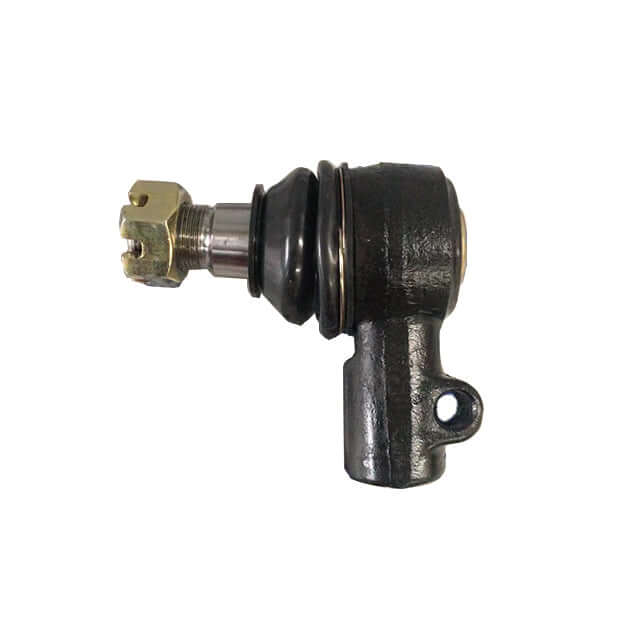
The ball joint occupies a structural position that no other component in the front suspension assembly shares. It is not exclusively a suspension component,t and it is not exclusively a steering component. It is the single pivot connection that serves both systems simultaneously, at the same interface, under the same load event.
At the outer end of the control arm, the ball joint connects directly to the steering knuckle or hub carrier, creating the articulation point that allows the wheel hub to steer left and right while the suspension simultaneously travels up and down. Every steering input the operator makes passes through the ball joint. Every vertical load the wheel encounters under the axle load passes through the ball joint. Every lateral force generated during loaded cornering, machine articulation, and bucket engagement with the material face all of it passes through the same tapered stud and housing interface.
This load convergence makes specification accuracy critical in a way that applies to few other components in the suspension system. A ball joint that deviates from the OEM-specified taper angle, stud diameter, or angular travel range does not just fit incorrectly at the installation stage; it changes the load distribution across the control arm it connects to, the wheel hub assembly it supports, and the steering geometry the machine depends on for directional control. Confirming the correct part for the specific model and axle position before procurement is not a procedural formality;y it is the foundation of a ball joint replacement that delivers its rated service life.
Upper and Lower Ball Joints One System, Two Distinct Load Profiles
The majority of heavy equipment front suspension configurations use a ball joint at both ends of the wheel hub travel arc, upper and lower. Both joints serve the same fundamental articulation function, but they operate under meaningfully different load intensities, and they fail in characteristically different ways.
Upper Ball Joints on Heavy Equipment
The upper ball joint on a wheel loader or backhoe loader carries a lower proportion of total vertical axle load than the lower joint, but manages a wider angular displacement range as the suspension cycles through its full travel arc. That angular demand makes seal integrity the defining engineering challenge at the upper position. A boot seal that cannot maintain contamination exclusion across the full articulation range of the joint will allow abrasive material into the grease interface long before the joint develops any structural stiffness or visible bearing wear.
Upper ball joint degeneration, therefore, re tends to present as play before it presents as stiffness. Grease contamination degrades the bearing surface gradually, clearance develops at the interface, and that clearance is felt first as an indistinct knock during slow-speed steering movements or as a vague directional instability under load. Because the upper joint carries less vertical load, it can continue operating with detectable play for a number of production shifts before the machine develops obvious symptoms, which is precisely the characteristic that causes it to remain in service well past its serviceable condition on machines where maintenance inspection does not specifically target the upper joint as a priority item.
Lower Ball Joints on Heavy Equipment
The lower ball joint carries the dominant share of vertical load from the wheel hub assembly through every loaded work cycle. On a fully loaded wheel loader during bucket engagement with the material face, the lower ball joint on the loaded axle simultaneously manages the combined weight of the machine's front-end payload and the dynamic forces of the digging cycle through a single tapered stud and housing.
This sustained load intensity means lower ball joint wear is typically faster and more operationally consequential than upper joint degradation. Where the upper joint deteriorates gradually through contamination-driven clearance development, a lower joint that has been left in service beyond the first detectable play indicator is exposed to a structural failure mode, stud separation from the housing that results in immediate loss of wheel hub positional control. Scheduling a ball joint replacement on your loader at the first confirmed sign of play at the lower position is the correct and only prudent maintenance decision. The cost comparison between a planned ball joint assembly replacement and an emergency structural recovery on a machine that has experienced lower joint separation is not a marginal calculation.
Why Contamination Is the Primary Determinant of Ball Joint Service Life
The engineering specification of a ball joint load rating, taper angle, and stud hardness determines its capacity under clean operating conditions. What actually determines service life on a construction site or mining operation is contamination exclusion, and that function belongs entirely to the boot seal.
Ball joints on heavy equipment operate at ground level on machines working in stone dust, quarry aggregate, mineral fines, and wet clay, the most abrasive operating environments in any industrial equipment category. The entire barrier between the grease-lubricated bearing interface and that environment is a single elastomeric boot seal. When that seal fails through abrasion contact with the ground, thermal cycling fatigue, UV degradation, or a mechanical impact from a stone strike, the abrasive material enters the bearing cavity, ty and the failure sequence begins immediately.
The progression is rapid and self-reinforcing. Abrasive material destroys the grease film, metal-to-metal contact initiates at the ball surface and housing race, the clearance that develops increases the rate of material ingestion, and the accelerating wear cycle compounds with every articulation movement. A ball joint operating in contaminated conditions after seal failure does not degrade at the same rate as a sealed joint that has reached its mechanical wear limit; it degrades at a rate determined by the abrasivity of the material that has entered, which in most site environments means the joint's remaining service life is measured in days, not months.
This is why seal compound specification carries equal weight with dimensional accuracy when evaluating a ball joint assembly. At Imara Engineering, we confirm the seal specification alongside the taper, load rating, and angular travel range before any ball joint assembly is supplied for a supported application.
Machine Platforms We Cover
Our heavy equipment ball joint inventory is catalogued and stocked across the following OEM platforms:
Caterpillar (Cat)
- Cat 966 ball joint — upper and lower wheel loader front axle positions, individual units, and complete ball joint kits for the Cat 966 platform.
- Cat wheel loader ball joint range covering the Cat 972 and broader Cat 900-series wheel loader platforms, where dual ball joint front axle geometry is specified.
Komatsu
- Komatsu WA380 ball joint — upper and lower positions for the Komatsu WA380 wheel loader, stocked as individual replacements and complete ball joint kits.
- Komatsu wheel loader ball joint range for WA-series platforms, confirming correct taper and angular travel specification across front axle positions.
JCB
- JCB 3CX ball joint — upper and lower positions for the JCB 3CX backhoe loader, available as individual units and complete kits.
- JCB backhoe ball joint range for the broader JCB backhoe loader series, including wheel loader platforms where dual ball joint suspension geometry is specified.
John Deere
- John Deere ball joint assemblies for wheel loader platforms — upper and lower front axle positions, individual replacement units,s and kit configurations available.
Case
- Case backhoe ball joint assemblies for Case backhoe loader and wheel loader platforms — upper and lower positions, individual and complete kit options stocked.
If your model is not listed above, contact our team with the machine serial number, RR, and we will confirm the correct specification and stock availability before any order is placed.
Five Field Indicators That a Ball Joint Requires Replacement
Ball joint wear on properly maintained heavy equipment rarely presents as a sudden structural event without prior warning. These are the five most reliable field indicators for which immediate inspection and, in most cases, planned replacement is required:
- A knocking or clunking during slow-speed full-lock steering movements, any audible metallic contact at the front suspension during a controlled slow-speed steering cycle,e confirms that play has developed at the ball joint interface and bearing surfaces are no longer in continuous grease contact.
- Steering vagueness that persists after tie rod ends have been confirmed serviceable when the tie rod end condition has been checked and the steering imprecision remains, ball joint play is the next diagnostic priority, with the upper joint position the most frequent source.
- Visible boot seal damage, tearing, or displacement from its seat. A compromised boot seal means the bearing cavity has already had unprotected exposure to the operating environment. The joint may still be articulating, but its remaining service life has been materially shortened from the moment of seal breach.
- Grease that is dark, gritty, or visibly contaminated at the boot interface during routine service expelled grease with these characteristics confirms abrasive material has entered the bearing, and the joint should be replaced at the current service event, not deferred to the next scheduled interval.
- A consistent directional pull during straight-line travel on a level surface that tyre pressure correction does not resolve — a ball joint with developed clearance allows the wheel hub to move marginally outside its constrained travel arc, producing a directional bias that persists regardless of tyre condition or adjustment.