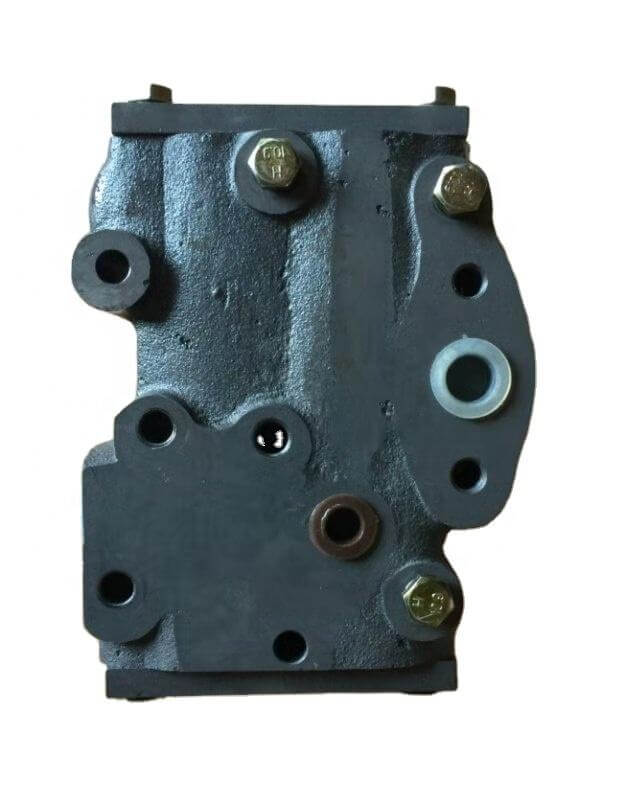
What Track Adjusters Do And Why Tension Is the Most Critical Undercarriage Variable
The track adjuster, also called a track tensioner, front idler assembly, or recoil spring assembly is mounted at the front of the track frame behind the front idler wheel. Its function is to push the idler forward under controlled pressure, stretching the track to the correct tension across the full undercarriage loop.
On hydraulic track adjusters the standard configuration on most modern excavators the tension is maintained by a grease-filled hydraulic cylinder. The cylinder pushes a yoke that bears against the idler mounting, holding it at the correct forward position under operating loads. As the track chain or rubber track stretches through normal wear over time, grease is added to the cylinder through a grease nipple to advance the idler forward and restore correct tension.
On recoil spring track adjusters common on bulldozers and some older excavator models a heavy-duty coil spring sits between the idler yoke and the track frame, providing a cushioned tension that absorbs the impact loads of track operation while maintaining a baseline tension across the system.
Both systems share the same failure modes. The hydraulic cylinder develops a leak through seal degradation, corrosion, or physical damage to the cylinder body and loses its grease charge progressively. The recoil spring fatigues or breaks, losing the preload that maintains baseline tension. In both cases the result is the same: a track running at incorrect tension that degrades every other component in the undercarriage system from that point forward.
Warning Signs, When Your Track Adjuster Needs Attention
Track adjuster failure communicates itself through the machine's track behaviour before it becomes a visible component failure. These are the signals across your excavator or bulldozer undercarriage parts that demand immediate investigation:
-
Track requiring more frequent re-tensioning than normal — the most consistent early warning sign of hydraulic cylinder seal degradation. A correctly functioning track adjuster holds tension without requiring regular addition of grease between service intervals. If you are adding grease more than once between 250-hour service intervals, the cylinder is leaking.
-
Grease weeping from the track adjuster area at the front of the track frame — hydraulic cylinder seal failure. The grease charge is escaping and the cylinder is losing the pressure that holds the idler in its correct forward position.
-
Track visibly loose or sagging on the lower run when the machine is stationary — the track adjuster has lost sufficient tension that the slack is visible without measurement. At this point the track is already running under significantly incorrect tension and the undercarriage system has been absorbing the consequences.
-
Track derailing on turns or on uneven terrain — advanced tension loss. The track has insufficient tension to remain guided on the idler and roller flanges under the dynamic loads of machine operation. This is an immediate stop-and-inspect situation.
-
Abnormal noise from the front of the track frame during travel — recoil spring fatigue or breakage. The track adjuster is no longer absorbing impact loads those loads are transmitting directly through the track frame with every terrain impact.
-
Idler moving rearward under operating load rather than holding its position — the track adjuster cylinder has lost pressure or the recoil spring has failed to the point where it can no longer resist the rearward force the track exerts on the idler under load.
Track Adjuster Specifications Getting the Right Assembly for Your Machine
The correct track adjuster assembly specification is defined by four parameters and incorrect specification produces either an assembly that does not fit the track frame or one that cannot maintain the correct tension range for your specific machine:
-
Cylinder bore and stroke — the hydraulic cylinder bore diameter and maximum stroke determine the tension adjustment range available. The bore and stroke must match the track frame geometry and the track adjustment range required for your specific machine model. An under-bore cylinder cannot develop sufficient pressure to tension the track to manufacturer specification.
-
Recoil spring specification — spring free length, compressed length, and spring rate must match the OEM specification for your machine. An under-rated spring collapses under peak impact loads and cannot maintain baseline tension. An over-rated spring transmits impact loads through the track frame rather than absorbing them.
-
Yoke and mounting dimensions — the adjuster yoke must interface correctly with the idler mounting bracket and the track frame recess. Yoke dimensions vary between machine models and in some cases between production years of the same model.
-
Seal specification for the hydraulic cylinder — the cylinder seals must be rated for the grease pressure and operating temperature range of your specific machine. Under-rated seals degrade faster and produce the progressive grease loss that is the most common track adjuster failure mode across the undercarriage parts category.
At Imara Engineering, every track adjuster assembly order is confirmed against all four parameters using your machine serial number. Provide your machine make, model, and serial number and we confirm the exact track adjuster specification before your order is placed.
Track Adjusters by Machine Brand
Our track adjuster inventory covers the most widely operated excavator and bulldozer brands all cross-referenced against OEM part numbers and all forming part of our broader undercarriage parts range.
Caterpillar Track Adjusters
Covering the Cat mini excavator range including the 301, 302, 303, 305, and 308 series and the Cat bulldozer range from D4 through D9. Cat track adjuster assemblies are manufactured to the precise cylinder bore, spring specification, and mounting dimensions of each Cat model. The Cat 303 and 305 track adjuster specifications are priority stock items. Cat D series bulldozer recoil spring assemblies are stocked across the most widely operated D series weight classes.
Komatsu Track Adjusters
Compatible with the PC series mini and compact excavator range from PC15 through PC78 and larger models including the PC200. The Komatsu PC200 track adjuster is a consistently demanded specification stocked as a priority item given the volume of PC200 machines across global construction fleets. The track tensioner excavator specification for the PC200 carries production year variations that must be confirmed by serial number before ordering. Komatsu D series bulldozer recoil assemblies are stocked across the D39 through D85 range.
Hitachi Track Adjusters
Stocked for the Hitachi ZX series including ZX17, ZX26, ZX35, ZX50, ZX75, and the ZX200. Hitachi track adjuster assemblies are confirmed against Hitachi OEM part numbers for cylinder bore, spring specification, and yoke dimensions across the ZX range. Always specify the ZX model designation when ordering Hitachi undercarriage parts ZX200, not PC200.
Other Brands
We also stock track adjuster assemblies for Kubota, Bobcat, Yanmar, JCB, Takeuchi, Doosan, and Volvo excavators. Contact the Imara Engineering team with your machine make, model, and serial number and we will confirm availability.
OEM Quality, What Every Track Adjuster Assembly Is Built To
Every track adjuster assembly in our undercarriage parts range is held to four quality standards:
-
Cylinder bore machining tolerance confirmed against OEM specification — the cylinder bore must be machined to the dimensional tolerance that allows the piston to develop and hold the correct grease pressure across the tension adjustment range. An under-tolerance bore cannot maintain pressure and produces the progressive tension loss that is the most common track adjuster failure mode.
-
Recoil spring rate and fatigue rating matched to machine weight class — the spring must absorb the peak impact loads of your specific machine at its operating weight without collapsing or fatiguing before its rated service life. Spring rate and fatigue rating are confirmed against the OEM specification for each machine weight class.
-
Hydraulic seal specification rated for operating pressure and temperature — seal grade confirmed for the grease pressure and operating temperature range of each machine family. Under-rated seals produce premature cylinder leakage that compounds every other undercarriage wear mechanism simultaneously.
-
Yoke and mounting interface confirmed against OEM track frame geometry — dimensional accuracy of the yoke and mounting interface confirmed against the OEM parts database. An incorrectly dimensioned yoke creates abnormal load distribution on the idler mounting that accelerates idler shaft wear and seal failure simultaneously.
OEM track adjusters carry a brand premium above equivalent quality aftermarket specification. At Imara Engineering, the specification standard, seal grade confirmation, and fitment guarantee are the same. The premium is not.
Track Adjusters in the Context of the Full Undercarriage System
The track adjuster sits at the centre of three critical undercarriage system relationships and its condition affects all three simultaneously:
-
Idler wheel condition — the track adjuster and front idler work as a paired assembly. A worn idler shaft bore or damaged idler mounting reduces the adjuster's ability to hold the idler in its correct position. Always inspect idler wheel condition alongside any track adjuster replacement fitting a new adjuster to a worn idler produces a system that cannot maintain tension correctly from day one.
-
Track roller and carrier roller service life — incorrect track tension from a failing adjuster is the single most consistent cause of accelerated roller wear across the full undercarriage system. Every roller in the system is overloaded or under-supported from the moment the adjuster loses its correct tension setting.
-
Rubber track and track chain service life — over-tensioning from a stuck or seized adjuster accelerates rubber track compound cracking and steel track chain pin wear simultaneously. Under-tensioning from a leaking adjuster causes track sag and impact damage to the inner track surface on the lower run.
Industries We Supply Track Adjusters To
-
Construction & Civil Engineering — excavator track adjuster assemblies for machines on active construction programmes where incorrect track tension degrades every undercarriage component simultaneously and turns a routine tensioning check into an unplanned undercarriage repair
-
Mining & Quarrying — bulldozer and large excavator track adjuster assemblies for machines operating on rock and abrasive aggregate where recoil spring fatigue from impact loads is the primary adjuster failure mode
-
Agriculture & Land Management — compact excavator and bulldozer track adjusters for machines operating in wet conditions where hydraulic cylinder seal specification for moisture and corrosion resistance determines service life
-
Landscaping & Garden Construction — mini excavator track adjuster assemblies for U series, KX series, and E series machines where correct tension maintenance directly protects rubber track service life and machine stability on finished surfaces
-
Plant Hire & Rental Fleets — track adjuster assemblies across mixed-brand hire fleets where consistent quality and reliable lead times define the supplier relationship. Imara Engineering supplies hire operators with trade pricing and serial number verified specifications as standard.